
72W E-Bike & Electric Scooter Power Adapter Buyer Guide
Understanding what goes into a 72W power adapter for e-bikes and electric scooters is not as straightforward as it might first appear. Sourcing teams are often tasked with matching the unit to a charger port, battery system, or aftermarket accessory without introducing the risk of field failures. The real challenge extends far beyond wattage. It comes down to compatibility, connector types, thermal performance, and whether the adapter is truly engineered for the specific load profile you have in mind.
For engineers and product teams, the decision is rarely about selecting a generic power supply—it is about avoiding mismatches that lead to nuisance returns, slow charging, or premature component wear. This is especially critical in compact mobility products, where the external power brick or inline module is often confined to tight spaces, handled frequently, and expected to withstand rigorous everyday use.
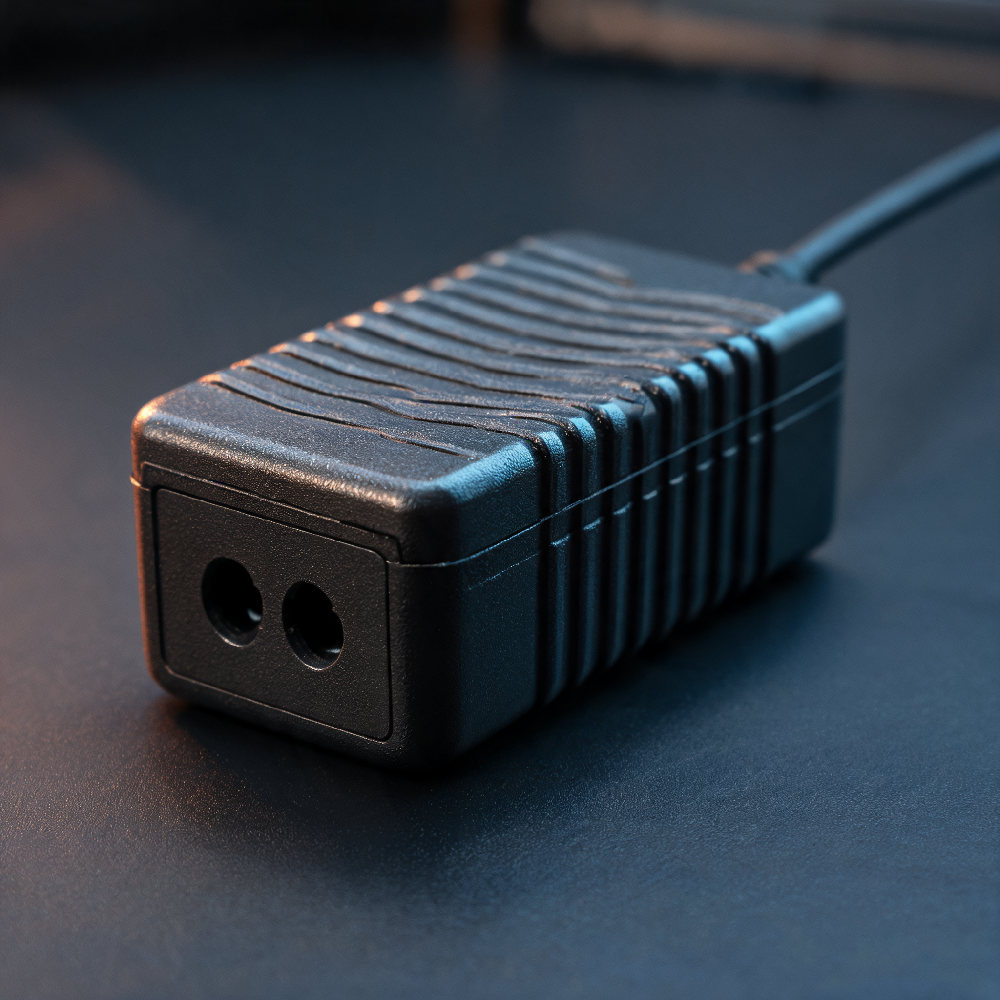
From a form-factor standpoint, this unit appears to be a black rectangular adapter with a matte plastic shell, a ribbed or wavy top surface, and vertical side ribs that likely improve grip and create the impression of enhanced heat dissipation. The casing looks like a single molded piece with a visible seam line, typical of injection-molded power accessories. A fixed cable exits from the rear or side, while the front end features a recessed 2-pin figure-8 style AC inlet, visually similar to an IEC 60320 C7/C8 configuration.
These visible details are helpful, but they do not reveal the essential electrical characteristics. Output voltage, current, polarity, and load-side plug configuration cannot be determined from appearance alone. This is a crucial point that many buyers overlook: a visually identical adapter can be entirely different electrically, and in the context of e-bike or scooter charging, that discrepancy is far from a minor detail.
Wattage alone does not settle the specification. The 72W figure is a useful headline, but it is only one element of the selection process. In mobility applications, the actual charger or adapter must align with the battery system and the expected input profile of the device. A 72W rating may indicate moderate charging capacity, but the real question is whether the unit delivers the correct DC output and whether its protection behavior is compatible with the battery management system.
When buyers treat wattage as the complete story, they often run into preventable problems: a connector that looks right but is keyed differently, an output voltage that is close but not exactly correct, or an adapter that runs too hot in enclosed conditions. A practical caution here: if the label lacks clarity, do not assume the unit is suitable for an e-bike or scooter battery just because the housing appears compact and the rating seems plausible.
Before specifying this type of adapter, there is a practical buyer checklist worth following. First, confirm the electrical output. Check the output voltage, current, and polarity from the label or datasheet—these are non-negotiable. If the adapter is intended for charging, verify that the charging profile is appropriate for the battery chemistry and management circuitry.
Second, match the connector and inlet arrangement. The product features a figure-8 style AC interface, but that does not indicate the output connector. Buyers should confirm both ends: the AC side and the load side. In sourcing, this is where simple-looking parts become expensive mistakes.
Third, review thermal and enclosure considerations. A ribbed exterior may improve grip and suggest better venting, but actual thermal performance depends on the internal design. If the adapter will be placed under a desk, inside a cabinet, or at a vehicle charging point, make sure there is adequate room for heat dissipation and cable strain relief.
Fourth, decide whether the unit is intended for OEM, replacement, or accessory use. Replacement chargers for mobility products typically require tighter compatibility than general-purpose consumer adapters. An aftermarket accessory may allow for broader usage, but an OEM replacement should be matched conservatively.
In the broader product landscape, this type of power adapter fits a well-established pattern. Externally powered electronics often rely on compact AC/DC modules because they keep heat and bulk outside the main device. This approach is common in set-top boxes, printers, chargers, audio equipment, and small industrial electronics. For e-bikes and electric scooters, the same packaging logic applies, even though the electrical demands are usually more specific. The advantage is clear: reduced onboard complexity. The tradeoff is that the external adapter becomes a critical component, not an accessory to be overlooked.
From a procurement standpoint, the adapter should be treated as part of the entire product system. That means evaluating mechanical fit, cable routing, handling, and replacement behavior—not just the nameplate rating.
Buyers often make several common mistakes. The first is assuming all 72W adapters are interchangeable; they are not. The second is overlooking the exact output plug geometry. The third is buying based on appearance alone and discovering the unit is AC/DC when the application requires AC/AC, or vice versa. Since the internal electronics are not visible, the only safe approach is to rely on labeling and supplier documentation.
Another frequently overlooked issue is real-world handling. A compact inline housing may be convenient, but if the cable exits in a way that creates stress points, field failures are likely. That is a small detail on paper but a significant problem when warranty returns begin to pile up.
Before placing an order, a sourcing manager should request the full electrical specification, connector drawings, housing dimensions, and exact product labeling. If the adapter is being considered as a replacement supply, request a sample and verify the fit against the existing device before approving any volume purchase. For mobility applications, check whether the charger matches the battery's charge window and whether the unit can operate under the intended ambient conditions.
If these basics are not available, pause the order. A neat-looking adapter is easy to buy but much harder to undo when it does not match the product it was meant to support.
As a next step, if you are evaluating a 72W e-bike and electric scooter adapter for procurement, replacement, or product integration, start with the label and connector drawings, then compare them against the battery or device requirements. This simple discipline helps prevent the usual round of returns, rework, and field complaints.