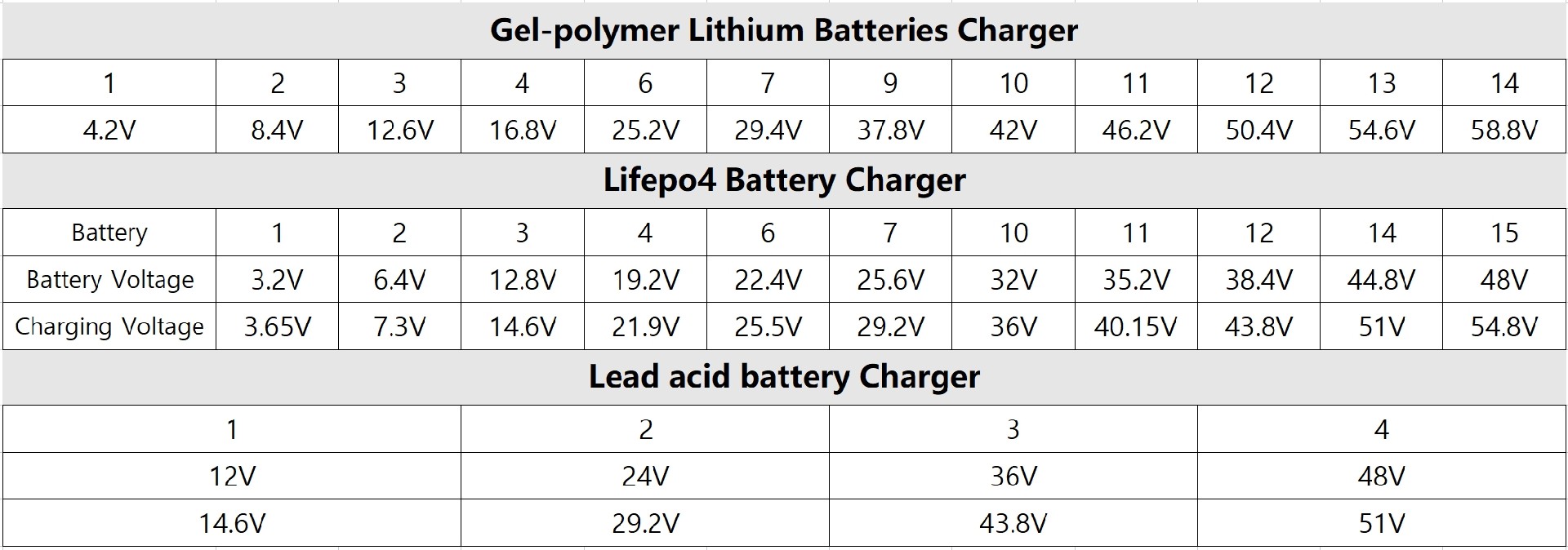
Lithium Battery Voltage Classification & Application Chart

Reference for Smart Charger Selection
Match your battery specifications with the table below to select the correct charger:
| Nominal Voltage | Max Charging Voltage | Battery Series (S) | Common Applications & Vehicle Types |
|---|---|---|---|
| 12V | 12.6V | 3S | Small portable power stations, DIY electronic devices, LED lighting systems |
| 24V | 29.4V | 7S | Kids electric scooters, electric wheelchairs, lightweight folding e-bikes |
| 36V | 42V | 10S | Standard commuter e-bikes (Entry models of Bosch, Giant, Bafang, QWIC) |
| 48V | 54.6V | 13S | Premium e-bikes & daily commuter e-scooters (Haibike, Specialized, Stella) |
| 52V | 58.8V | 14S | High-performance e-scooters, long-range modified DIY e-bikes |
| 60V | 67.2V | 16S | High-speed electric scooters, delivery fleet e-bikes |
| 72V | 84V | 20S | High-power electric motorcycles, off-road electric dirt bikes |
| 80V | 92.4V | 22S | Heavy-duty cargo e-bikes, industrial light electric vehicles (LEVs) |
| 96V | 109.2V | 26S | High-performance electric motorcycles, racing light electric vehicles |
Quick Calculation Tip
Battery Series (S) × 4.2V = Maximum Charging Voltage Example: 10S × 4.2V = 42V (Full charging voltage for 36V nominal battery pack)