
Drone & Robotics Charger Output Specifications Complete Guide
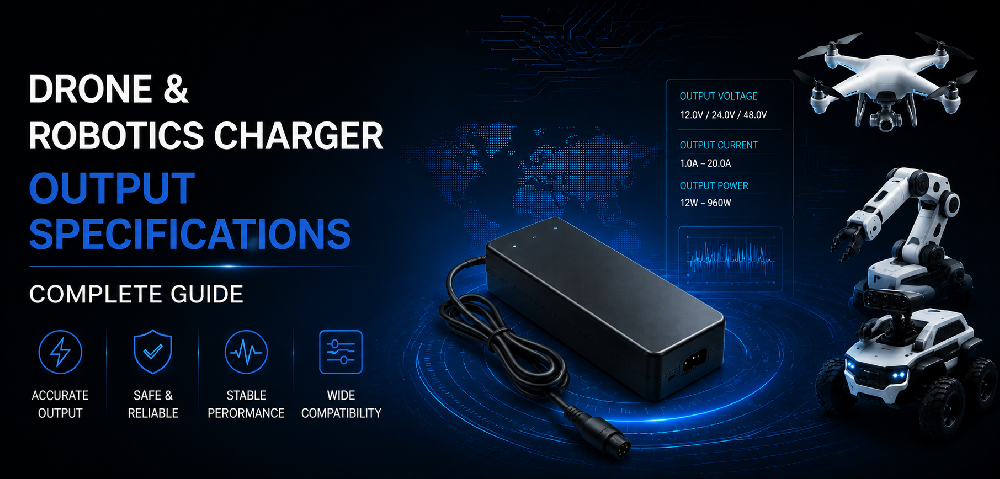
Drones and mobile robots have become essential equipment for modern industrial automation, widely used in agricultural spraying, factory automated logistics, underwater infrastructure inspection and other heavy-duty scenarios. All of them rely on lithium batteries for power supply.
The efficiency of your devices is directly determined by matching charging equipment. For fleet managers, engineers and procurement staff, mastering drone charger output specs can cut equipment downtime, reduce long-term costs and meet strict safety standards.
This article sorts out core charging electrical parameters and classified charging schemes for different industrial devices.
1. Three Core Charger Output Parameters
Ignore vague marketing slogans; judge charging performance by these three precise electrical indicators:
| Parameter | Detailed Explanation |
|---|---|
| Battery Series Count (S) & Nominal Voltage | LiPo and LiHV batteries are made of series-connected single cells marked as "S". Standard LiPo single cell max charging voltage: 4.2V; LiHV single cell: 4.35–4.4V. The charger output voltage must fully match your battery’s series configuration. |
| Charging Current (Amperage) | Current controls charging speed. Industrial chargers support adjustable current to fit different charge rates and avoid cell overheating damage. |
| Total Output Power (Wattage) | Power = Voltage × Current. Higher overall power allows simultaneous high-voltage & high-current fast charging on multiple ports. |
2. Tiered Charger Specs for Different Devices
Classified by equipment load and power demand, four standard industrial charging specifications:
General Parameter Table for All Tiers
| Grade | Battery S Range | Output Voltage Range | Single-channel Current | Max Output Power | Common Connectors | Main Application Scenarios |
|---|---|---|---|---|---|---|
| Tier 1 Light Equipment | 1S–3S | 3.7V–12.6V | 0.5A–3.0A | 10W–40W | USB-C PD, JST-PH, XT30 | Indoor research robots, mini survey drones, teaching robotic arms |
| Tier 2 Commercial Fleet | 4S–6S | 14.8V–26.1V | 5.0A–25.0A | 100W–1000W | XT60, XT90, JST-XH balance wire | Security inspection drones, medium unmanned ground vehicles, FPV inspection devices |
| Tier 3 Industrial & Agricultural | 6S–14S | 22.2V–58.8V | 20.0A–40.0A | 1200W–3000W | Anti-spark AS150, XT90-S, multi-pin smart plugs | Heavy-load crop spraying drones, long-distance survey UAVs, offshore underwater ROV submersibles |
| Tier 4 Heavy-Duty High-Voltage | 12S–20S+ | 44.4V–84.0V (custom higher voltage available) | 50.0A–120.0A+ | 3000W–9000W+ | Custom heavy-duty blind-mate connectors, large-current quick disconnect terminals | Large cargo delivery drones, warehouse AGVs, industrial defense UAVs |
3. Smart Charging Functions Beyond Basic Power Supply
High-end industrial chargers are integrated energy management centers with three intelligent core systems:
3.1 Independent Multi-Channel Power Distribution
Equipped with multiple independent MCU control channels. For example, a 2400W dual-channel charger will not split power equally; it dynamically distributes power according to each battery’s remaining power. It prioritizes charging low-power batteries without voltage drop.
3.2 Intelligent Bus Data Communication
Large industrial batteries are built with BMS protection boards. Premium chargers connect to BMS via multiple communication protocols:
| Supported Protocol | Core Working Mechanism |
|---|---|
| CAN bus / SMBus / I2C | Real-time reading of single-cell temperature, charge cycles and internal resistance; automatically adjust CC/CV charging curve to prevent thermal runaway and extend battery service life |
3.3 Automatic Battery Maintenance & Storage Mode
Lithium batteries stored at full charge (4.2V/cell) or empty (3.0V/cell) will suffer permanent capacity loss, bulge or internal damage. Industrial chargers have dedicated storage mode, automatically adjusting battery voltage to a stable storage value (3.8V–3.85V per cell) for long-term idle storage.
Mevke Industrial Charging Solutions
Mevke develops commercial multi-channel high-power chargers for high-demand drone and robot fleets. Our products adopt high-efficiency SiC power chips, optimized heat dissipation structure and intelligent data recording to maximize charging efficiency.
Custom multi-channel schemes, high-voltage charging systems and OEM cooperation are available. Contact Mevke for more details.